Mock Drill – Plan Before an Emergency Strikes

A mock drill is a planned emergency simulation conducted to evaluate how effectively employees and management respond to incidents such as fire, gas leaks, chemical spills, medical emergencies, or natural disasters. It helps organizations test their readiness and strengthen response systems before a real incident occurs.

This blog covers the importance of mock drills, the procedure to conduct them, key roles and responsibilities, and practical tips for ensuring safe and effective execution.

Importance of Mock drills in workplace safety

Mock drills play a critical role in strengthening workplace safety because they reveal how prepared employees are when an emergency strikes. They turn practical skills into real action and reveal things that normal training sessions never can.

In an actual emergency, employees do not think about the written procedures—they respond based on instinct and prior experience. Without proper practice, this can result in panic, delays, and unsafe decisions. Mock drills address this gap by providing structured, hands-on rehearsal of emergency actions.

Why it is essential:

  • Employees become more confident and react faster during emergencies.
  • Communication systems are tested to see if they really work when needed.
  • Evacuation routes and assembly areas are checked in practice.
  • Everyone gets clarity on their role and responsibilities.
  • Weak spots in the plan are noticed and improved.
  • Response time improves with regular practice.
  • Teamwork between departments becomes smoother.
  • Panic and confusion are reduced in real situations.
  • Overall emergency preparedness across the workplace becomes stronger.

Real-time evidence from India proves why mock drills are critical

  • A Directorate General of Mines Safety (DGMS) study found that during a mock mine fire drill, about 10% of workers failed to communicate an emergency correctly—showing how easily confusion occurs without regular practice.
  • Research from the hydrocarbon industry showed that companies that conducted regular mock drills saw a steady improvement in employee Knowledge, Skills & Abilities (KSA)—with drills increasing from 27 in 2008 to 53 in 2011, and performance improving along the way.

    ENQUIRE NOW

    These insights make one thing very clear: mock drills are not just a routine—they are a powerful tool to fine-tune your workplace emergency response time.
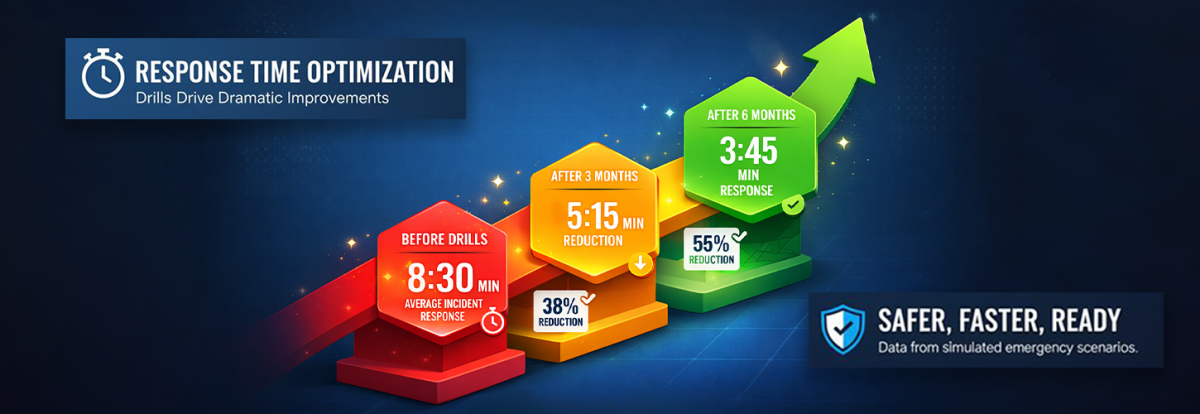
    Mock Drill Statistics

    How to Conduct Mock Drill: Step-By-Step Procedure with Example
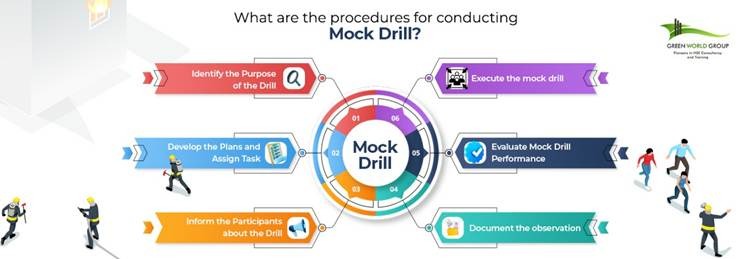
    Mock Drill Procedure

    • Step 1: Identify the Purpose of the Mock Drill
    • Step 2: Develop the Plan and Assign Roles
    • Step 3: Inform Participants about the Drill
    • Step 4: Execute the Mock Drill
    • Step 5: Evaluate Performance
    • Step 6: Document Observations and Improve

    Fire Evacuation Drill:

    Consider a manufacturing company conducting a fire mock drill to teach employees how to evacuate quickly and safely.

    To visually experience how a mock fire drill is carried out from start to finish watch the video : https://www.youtube.com/watch?v=h4n2wVhCzuU&t=72

    • Plan the Drill:

      Start by deciding what you want to evaluate, such as evacuation time or the alarm system’s performance. Assign responsibilities to fire wardens and safety officers to guide the process.

    • Inform Everyone:

      Let employees know about the drill in advance and clearly explain that it is only a practice exercise to prevent panic.

    • Sound the Alarm:

      Trigger the fire alarm to begin the drill and observe how quickly employees respond.

    • Evacuate the Premises:

      Employees should use the marked exit routes while wardens check their areas to ensure everyone leaves safely.

    • Gather at the Assembly Point:

      Once outside, move to the designated safe area away from the building.

    • Conduct Roll Call and Review:

      Confirm that everyone is present, then document the observation and briefly discuss what went well and what can be improved for the next drill.

    Who will conduct mock drill: Roles and Responsibilities

    Usually, mock drills are conducted by the training facility, safety consultants, emergency response team and experienced professionals who provide feedback and make recommendations for improvement.

    Organizations can conduct comprehensive and effective mock drills by coordinating with them to ensure emergency preparedness. Each role has a specific responsibility

    • Fire Warden: Guides employees during evacuation and ensures no one is left behind.
    • Safety Officer: Plans, organizes, and supervises the entire drill.

    • Employees: Follow instructions calmly and evacuate through the designated routes.
    • ERT (Emergency Response Team): Manages the simulated emergency and supports the evacuation process.
    • First-Aider: Provides immediate medical assistance and helps anyone who needs support.
    • Assembly Point Coordinator: Takes roll call and confirms that everyone has reached the assembly area safely.

    Purpose of Regular Mock drill in Workplace Safety

    The purpose of regular mock drill is to,

    • Identify hidden safety gaps before a real emergency exposes them
    • Familiarizes individuals with emergency procedures
    • Improve communication, coordination, and decision-making
    • Strengthen employee confidence and teamwork
    • Ensure every person knows exactly what to do, where to go, and whom to report to.

    Benefits of Regular Mock Drill practice at work

    • Take the least possible time for a safe evacuation.
    • Improve employee safety and protection during emergencies.
    • Minimize your property damage & maximize your business continuity.
    • Helps to identify the area using the nearest safe exit to be safe during natural disasters.
    • It reduces financial costs and the period of overall relief.
    • Enhance regulatory compliance and overall safety performance.

    Tips to conduct Safe Mock Drills at Work:

    Before the Drill During the Drill After the Drill
    • Assess the drill area for hazards
    • Assign fire wardens, floor marshals, and observers
    • Inform employees, visitors, and contractors in advance
    • Ensure alarms and communication systems are functional
    • Inform emergency services if required
    • Inspect alarms, extinguishers, sprinklers and emergency lights
    • Keep exits, evacuation routes, and assembly points clear
    • Monitor weather conditions for outdoor drills
    • Avoid real hazards (fire, chemicals, hazardous materials)
    • Keep first-aid support and trained responders ready
    • Give clear evacuation instructions
    • Observe employee behaviour and response
    • Time the evacuation process
    • Ensure safe movement to exits
    • Conduct headcounts at assembly points assembly points
    • Support employees needing assistance
    • Prevent panic, confusion, or unsafe actions
    • Review drill observations
    • Identify gaps and delays
    • Collect employee feedback
    • Update emergency procedures
    • Fix faulty safety equipment
    • Document drill findings
    • Assign corrective actions
    • Conduct regular training and drills (1–2 times per year)

    Common Mistakes to Avoid During Mock Drills:
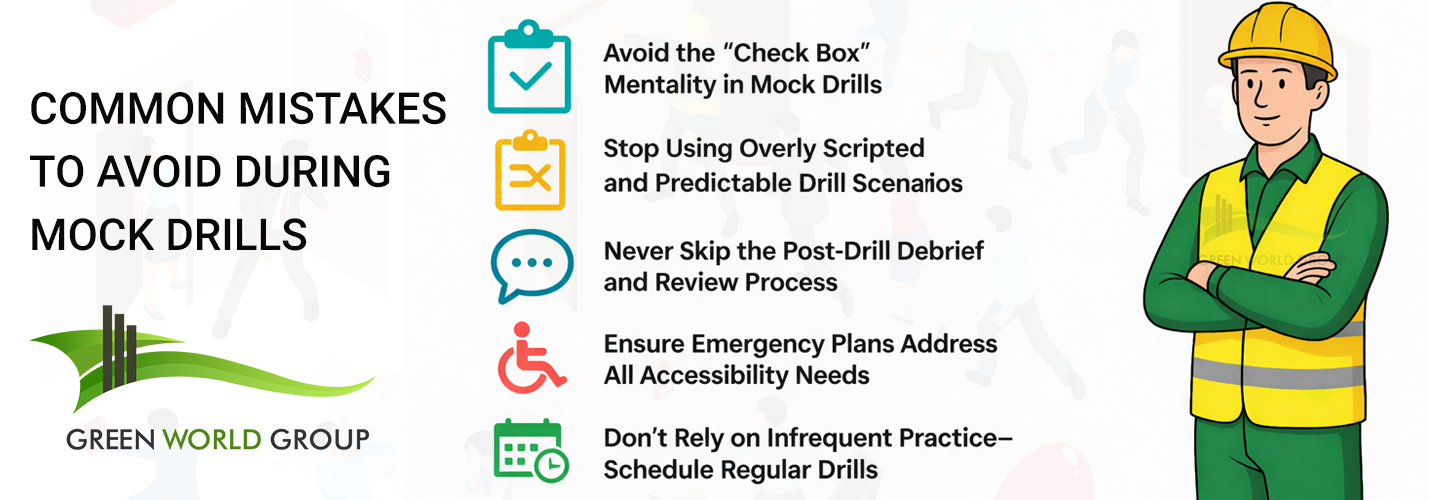
    Common Mistakes to Avoid During Mock Drills

    Conclusion

    In every workplace, where emergencies can happen without warning, preparedness is the best protection. Investing time and effort in regular mock drills today ensures safety for your employees, your workplace, and your business.

    At Green World our team of experts is ready to support your organization with a fully customized mock drill practice and training program tailored to your industry’s needs. With our guidance, your workforce will be better equipped, better trained, and better prepared for any emergency.

    Get in touch with us —because preparedness saves lives.

    Our recent projects

    Our recent projects

    Green World has now evolved into a strategic market player for staffing solutions on turnkey HSE projects across MENA and Pan-India. Our HSE culture is built on trust, service delivery, and safeguarding the well-being of our people, communities, and environment.